2.3. Discovering Softplus function and applying it
2.4. Why to have a smooth version of the Hinge Function ?
2. Hinge Loss
2.1. Introduction ATTACH
I worked on an assignment which asked us to make a mapping rule for a smooth Hinge Funtion which is attached at the last of the blog.
So basically a hinge loss function is a function for binary classification that aims to maximize the margin between two data clouds.
Suppose that that the two data clouds are apple and banana and we want to make a binary classifier which separates them
2.2. Comparison with ReLU
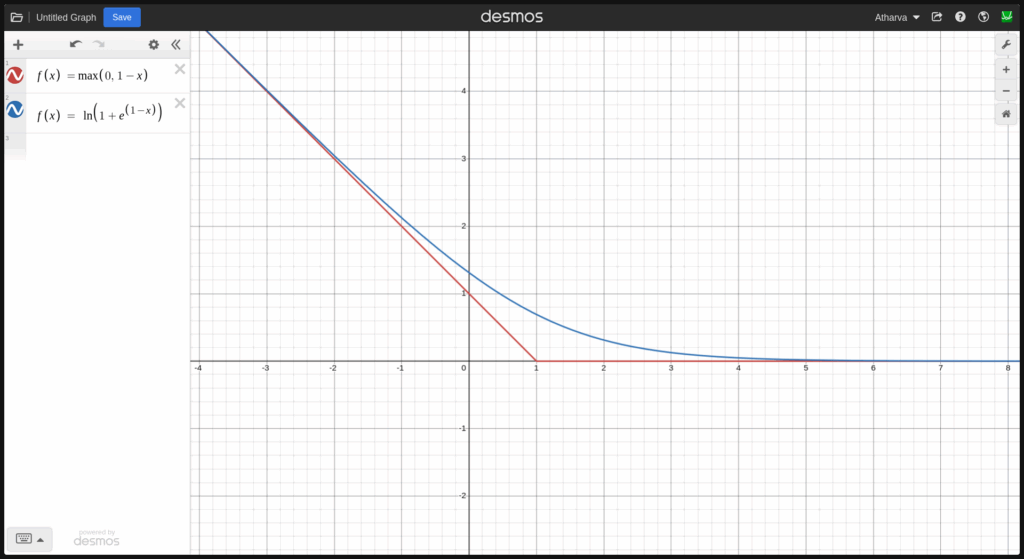
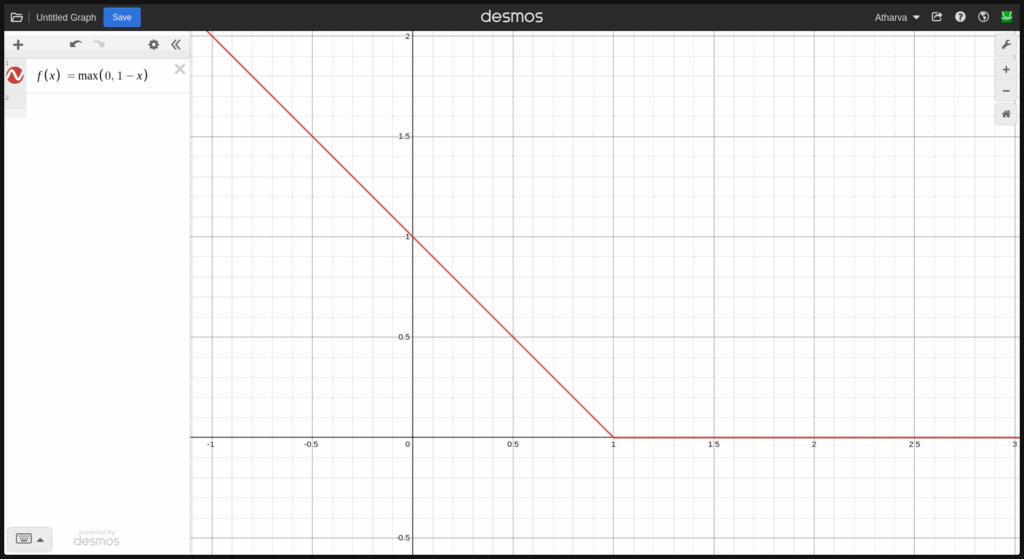
Me and my team compared this hinge loss function to a ReLU function( Rectified Linear Unit ), and figured out that it was a function which gave binary output but has threshold on the origin instead of what our case was ,(1,0). Anyways the function , Hinge Loss very similar to that of the ReLU.You can see that it as follows: ReLU -> & Our Hinge Loss ->
.
2.3. Discovering Softplus function and applying it
On googling smooth function of ReLU we figured out something called as a SoftPlus Funtion . You can simply google it for a structured definition but basically it is a function which smooth ens a ReLU function making it differentiable, i.e in this case not making the y zero at any instance. It is defined for a RELU as :
. Graph is attached at the end of the blog
This allows us to find the derivative of the Soft Plus Function:. This again has a formal function name which is Sigmoid Funtion. We will discuss about this is our next blog.
2.4. Why to have a smooth version of the Hinge Function ?
The whole point of talking about comparison with ReLu and then SoftPlus, and finally differentiating it get a sigmoid function is to make it differentiable.This is required us to work with something called a gradient descent and also to figure out the mapping rule for the smooth Hing Loss Function.
I switched to linux during the Lodha Genius Programme on my system this year. This change is attributed to one of my teaching assistant for the Quantitative Biology course, who inspired me to give this piece of technology a try. I am using Windows since 2013. I used Windows 7 for most of my life(till now) -> Windows 10 -> Windows 11. I have never researched about the philosophy of linux, its distros, community, features, nothing. But seeing someone using linux for one straight month in front of my eyes was enough to convince me to give it a try. So I dual booted fedora on my system along with Windows 11 and thus began my linux journey.
1.2. Linux
I will not make a mistake to say that I have reached a decent level at using the linux os, yet, but I have become comfortable with looking up for sudo command in gemini to fix something that is not allowing my laptop charge or to scroll through reddit to find a command which installs a particular package. The distribution which I use (fedora) has real nice GUI which is actually good for beginners like me. I haven’t found any major difficulty in using linux apart from having to attend teams meeting from a browser(nightmare). I discontinued fedora as the default boot for a month, where I needed a system which just worked (Windows) and doesn’t want the user to fix some bug in middle of a study session. I switched back to linux as the main os 2 weeks back and the transition has been pretty smooth so far, until I got doomed.
1.3. Emacs
Recently I started following a youtuber and streamer with the alias name jvsholz who livestreams learning japanese (nowadays). He introduced me to a software called Emacs, which he uses as his note taking application. He went through his file structure and the way that he documented he Personal Knowledge Base, which made me curious, whether it is better than my OneNote and Notion. After looking up youtube and some reddit posts, I figured out that there are community based on the type of text editor that you use, namely Emacs and Vim! Interestingly I already had some idea about these two due to a Lex Fridman podcast which I watched but never bothered to actually search. Believing this as a sign for a new shiny object. I went into a rabbit hole of Emacs.
1.4. Doom Emacs
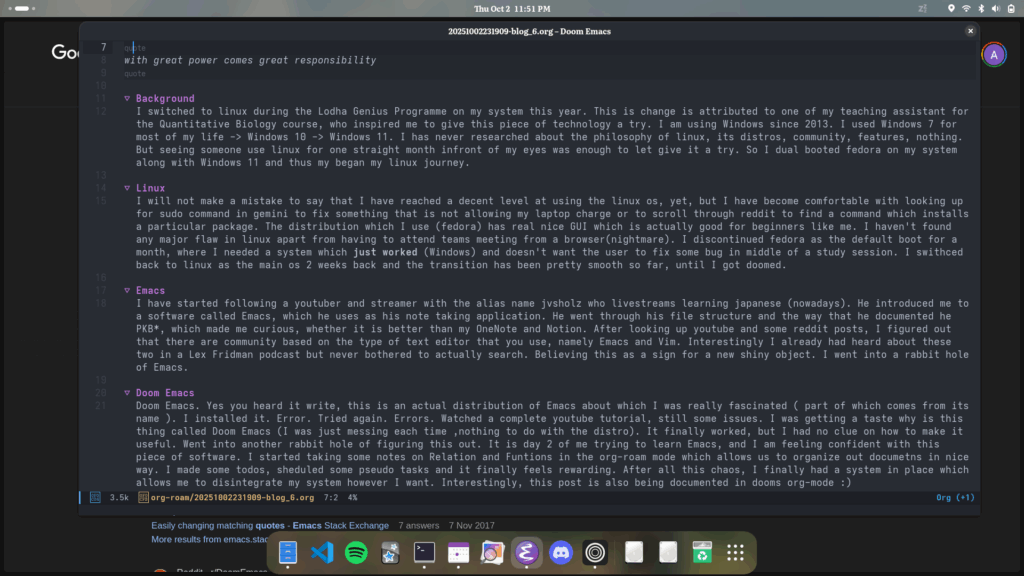
Doom Emacs. Yes you heard it right, this is an actual distribution of Emacs about which I was really fascinated to use ( part of which comes from its name ). I installed it. Error. Tried again. Errors. Watched a complete youtube tutorial, still some issues. I was getting a taste why is this thing called Doom Emacs (I was just messing each time ,nothing wrong with the distro). It finally worked, but I had no clue on how to make it useful. Went into another rabbit hole of figuring this out. It is day 2 of me trying to learn Emacs, and I am feeling a little bit confident with this piece of software. I started taking some notes on Relation and Functions in the org-roam mode which allows us to organize your documents in nice way. I made some todos, sheduled some pseudo tasks and it finally feels rewarding. After all this chaos, I finally had a system in place which allows me to disintegrate my system however I want. Interestingly, this post is also being documented in dooms org-mode : )
1.5. Why still windows 11
Why I still have windows 11 as a dual boot? I have some exam which requires a windows application to practice and attempt mock test. Will I completely switch to linux once the exam is done? Maybe. Will I keep using Emacs? Definitely.
1.6. Would I recommend this to the reader
So after reading this blog, will I recommend linux or emacs to you? yes! should you blindly just download arch and try out a whole week how to get your bloated windows 11 back? absolutely not. It really depends on your personal goals and willingness to learn such an advance piece of software and os. What level I am on this hierarchy of learning? 0, zero, zilch, kein. But will I keep trying? a 100%. So if you are someone who is into organization, then sure, give Emacs a try, who knows that you may become its fan too! danke, sayonara.
I was reading a book called “deep work” by carl newport last month, which I haven’t quite finished(time to start reading it again), and it changed the way I look at productivity.
he talks about how the intensity at which you work at really defines how productive you are. he believes that the focus with which you perform a particular task is equally important as the amount of time you do it, if not more. you may try doing a task for 12 hours with a low level of focus and get the task done somehow, whereas a person with intense focus could get the same task done in 3 hours of deep focus block (arbitrary example). One major flaw with the first approach is that it makes the person believe that this task actually required 12 hours and meanwhile this stark number of 12 hour of work also makes the person feel motivated to continue doing this habit.
trust me when i say this, “it is very easy to devote long hours to things which have a net positive impact on your life once you get these things in your life, but the true optimum(or rather maximum) is achieved when this act is used in its most robust form” The list follows.
Social Media Detox
A passion
motivation (* from the passion, not instant motivation -> that would take you at max weeks or some months not more than that)
and lastly “order”
I want to emphasize what I meant by “order” in the above list. Order can be thought of as in contrast to “pure chaos”, where you have no control of what is happening in your life, misery, no direction, no motivation, et cetra. For our purpose order could be thought of as organization and how you conduct yourself though this journey.
Coming back to the initial point, carl newport also provides use with a equation to quantify (again, intuition) our high quality deep working hours, which could be understood by the image attached below.
book recommendations:
deep work
digital minimalism
12:38 AM
atharva
*A note: the above mentioned list is not something which the author came up with from ground up, but referred from his learning of the books and the resources that he reads which stayed in his subconscious.