Category: september

  • biphasic sleep

    According to some sources, Sir Isaac Newton used to sleep only 2 hours a day (working 22 hours everyday). Some famous people including Leonardo da Vinci, Nikola Tesla, and Thomas Edison used to follow a specific type of sleep, called polyphasic sleep. “poly” referring to “many” and “phasic” referring to “phases”, i.e. sleep in many phases/cycles.

    Polyphasic sleep is historically linked to polymaths who optimized day for better productivity. Polyphasic sleep contrasts to traditional monophasic sleep.

    The term “polyphasic sleep” was coined by J. S. Szymanski,a psychologist who observed daily fluctuations in sleep activity patterns.

    nowadays monophasic sleep is the norm, but history suggests something else. It suggests that polyphasic sleep was common practice in many societies before industrialization.My reasoning why the practice dwindled after industrialization is as follows:

    Industrialization required people to work for long hours every day, especially men, therefore not allowing room for sleep in chunks throughout the day.

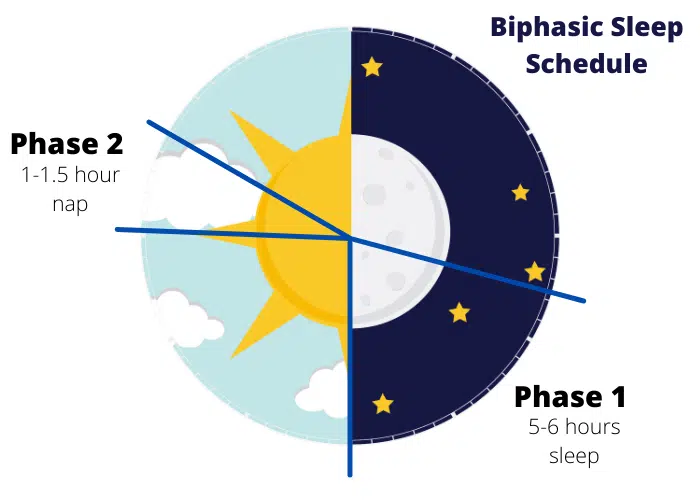
    I personally follow a specific phase type sleep known as “biphasic sleep”. A person sleeps in two chunks in 24 hours instead of the normal 7-9 hour sleep at night. If you take a 1-2 hour nap during afternoon then you too follow a biphasic sleep schedule unknowingly!

    As far as I have practiced this sleep schedule, I classify this in two sub categories

    • 4-4 hour schedule
    • 6-2 hour schedule

    I regularly try to get 6-7 hours of sleep, usually following the the 6-2 hour schedule ( slightly adapted -> (4-2.5 ) ). As of september 2025, I try to sleep around 23:30-24 and wake up at 5 A.M. . The next sleep phase starts around 14:00 or 15:00 and goes till 16:00 or 17:00 depending on the situation, respectively.

  • what is imposter syndrome

    if something is important enough, you still do it even if the odds are against your favor. ~Elon Musk


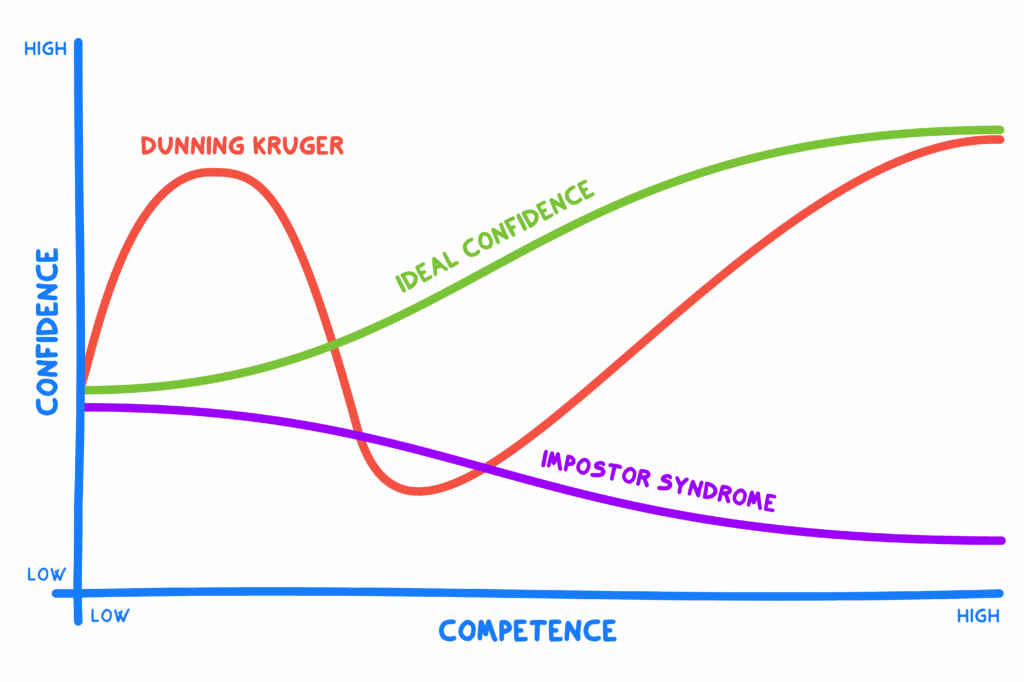
    yesterday i discussed the dunning-kruger effect and how people overestimate their ability at a certain skill, especially when they are just beginning to crawl. i also mentioned how there are two negative trajectories to the dunning-kruger effect. one is that one is not able to confront the reality and quits altogether. the other (which we are going to talk about) is that a person still keeps on learning and advancing in the skill parallel with the “ideal confidence” (ignoring time as a parameter here) but doesn’t gain confidence in their abilities to do work.

    this scenario is called the imposter syndrome. According to Wikipedia, stated as follows:

    a psychological experience in which a person suffers from feelings of intellectual and/or professional fraudulence.

    in many cases, the trigger for such a scenario could be comparing yourself with people who are, again, far ahead of you in the ladder of competence hierarchy. it is often stated as comparing your day one with someone else’s day thousand.

    by now i believe you got the understanding of what this syndrome really deals with. you might ask what could be a potential solution to this? and personally i haven’t figured that out yet myself. there are several narratives of how one looks at their drive for life. for example, a person like david goggins thrives by comparing himself to every other person in the world and that fact keeps a person like him going. if he doesn’t outwork his competition he isn’t succeeding according to him, which is completely fine for his use case.


    the above-mentioned example may or may not work for you, and the fun part is you might never come across a pre-existing solution for your specific problem.


    one thing that often helps me is to just follow your calendar (no matter if agi is invented). just sticking to what you are doing consistently and walking on your own trajectory is, in most cases, a better decision than giving up your entire calendar for chasing some other shiny objects.

    a video recommendation on the above topic

  • why being humble is important

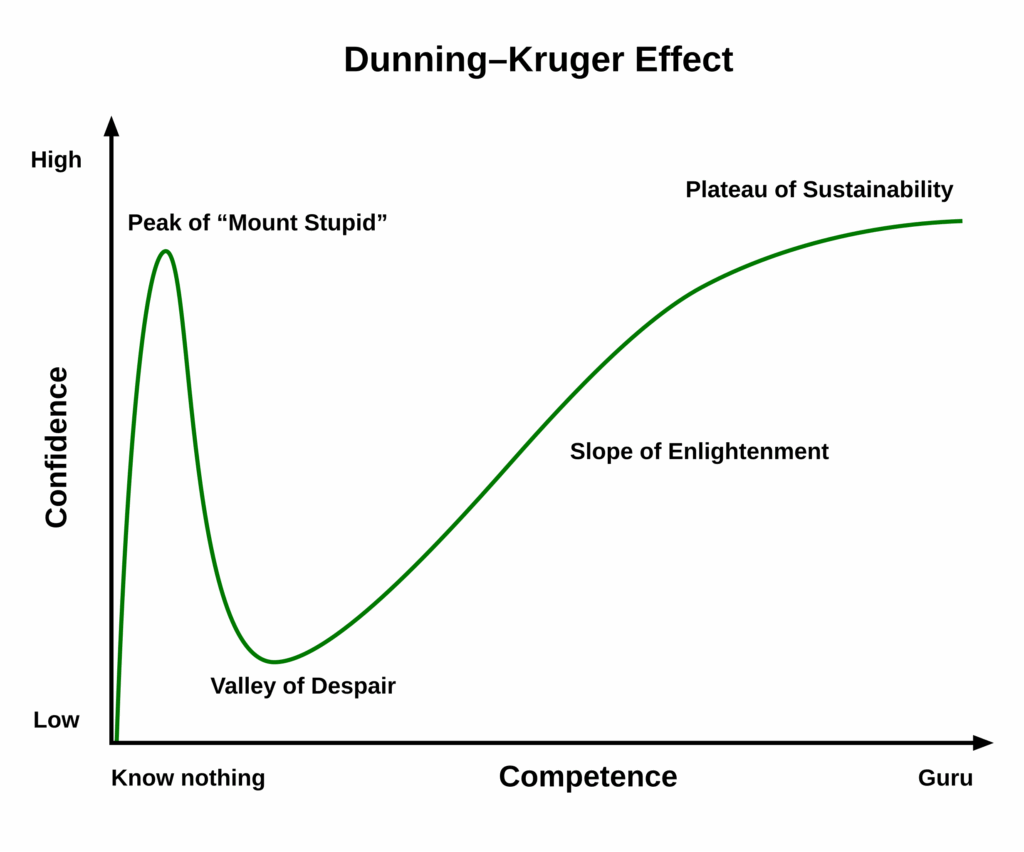
    A year ago, I watched a lecture by Lex Fridman on YouTube that discussed the Dunning-Kruger effect, and it’s a video I find myself returning to every now and then.

    According to Wikipedia, the Dunning-Kruger effect is stated as follows:

    The Dunning–Kruger effect is a cognitive bias in which people with limited competence in a particular domain overestimate their abilities

    Basically, this effect describes how people new to a field or domain try to comprehend their expertise after some initial learning. Their confidence skyrockets. They overestimate their skill level.

    I myself have been a part of this curve in many domains in my life(and am currently in the “valley of despair” in a few of them). The primary thing to learn from this effect is that it is not bad to feel good about one’s ability in a particular skill but to have a real benchmark and be humble in each competence level(assuming competence to be discrete). I myself try to be humble about everything I know and everything I don’t.

    The problem isn’t falling into the valley of despair, but that most of the people don’t even continue their competence journey once they are confronted with this reality. The real value to take away is to be persistent with your learning and never assume yourself to be the top of the world because there is always someone in some corner of the world who is performing far better than you.

    It is usually a good practice to stay around people (offline or online) who are further along the competence hierarchy, so that you stay grounded.

    unfortunately, I haven’t been able to find the link to the specific youtube video which has been referred to here. If you happen to find it, please email me at atharva{at}atharvasingh.com

  • how i revived my old thinkpad( and my childhood memories)

    a man finds pleasure in the most unimportant things amidst chaos


    i had my cs exam today. it went well, but what i want to talk about today is how, under the umbrella of preparing for my cs exam, i disguised myself and tried to fix my 12-year-old lenovo thinkpad l412.

    i probably am everything that you associate me with because of that thinkpad. my father gifted me this laptop on my fifth birthday in 2013. i remember playing road rash, surfing the internet on internet explorer, searching for the tallest man in the world, et cetera (good old days). i remember making scratch programs for flappy bird while watching a youtube tutorial.

    so, it did have some emotional memories associated with it, too.
    anyway, i opened that old mess up with just one screwdriver. this really is crazy compared to what laptop companies provide us with nowadays: soldered ram, soldered hard disks, and no back screws (why?). i figured out that the installed ssd was corrupted, and therefore, for it to work, i needed a bootable usb. i created a fedora bootable usb and plugged it in. i played around in the bios, then in the terminal, and it somehow worked.

    i am happy that it is working right now, but will i use it daily? maybe not. it is maxed out with 8 gb of ram (sounds funny? it is) and with an intel i5 processor. still, it doesn’t get done what my new device can. anyway, i’m happy that it revived some of the old memories and taught me how to remove an ssd from a laptop.