Category: Uncategorized

  • Time

    What is time?

    Time is the continuous progression of existence that occurs in an apparently irreversible succession from the past, through the present, and into the future.

    We all think that we are late for something or the another to begin with, but what is late? I agree that if you haven’t started your thesis and the deadline is tomorrow, then you by no means can do that (if you are not doomed to use AI to write your Thesis). But what about things that are not urgent? You may leave your whole life thinking that you always have time, but in a snap its gone. You start to think that it is already late now, and never actually start. It is well put that, “Now is the best time to start anything other than all the other options that you had previously”. You want to start learning math at 55, go ahead. You want to learn to program when you are 70? Start now.

    When we claim such a stance, it is equally important to implement what we decide. One of the example I can think of now is this blog. I was procrastinating to start my blog since last 2 years, and you now will understand what I meant by urgency. Blogging is never urgent, no deadlines, no high authority pressurizing you or your parents asking you to do it everyday.

    As a takeaway, what was one thing that you always wanted to do, but didn’t yet? Start today!

  • Hinge Loss


    1. Table of Contents

      • 2.1. Introduction   
      • 2.2. Comparison with ReLU
      • 2.3. Discovering Softplus function and applying it
      • 2.4. Why to have a smooth version of the Hinge Function ?

    2. Hinge Loss


    2.1. Introduction   ATTACH

    I worked on an assignment which asked us to make a mapping rule for a smooth Hinge Funtion which is attached at the last of the blog.

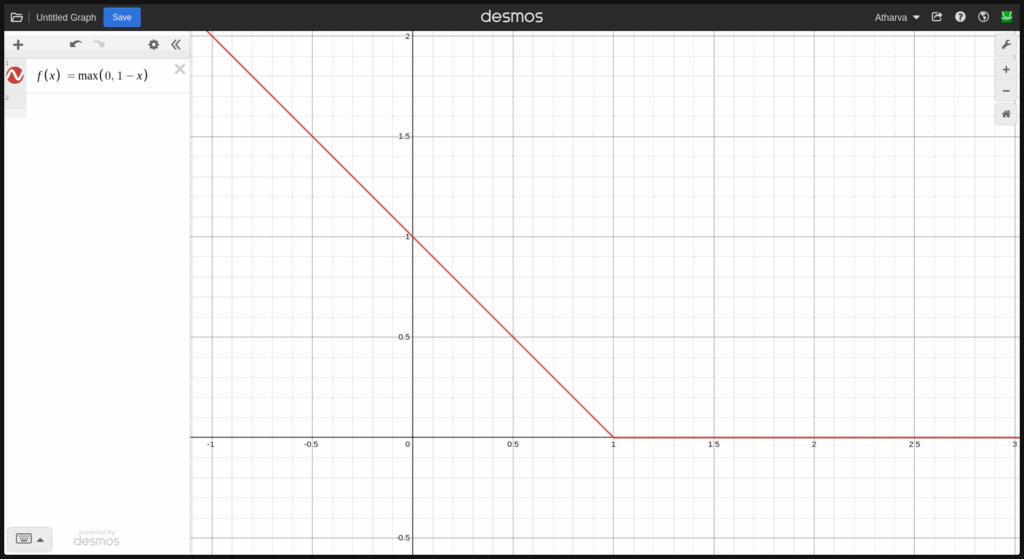
    So basically a hinge loss function is a function for binary classification that aims to maximize the margin between two data clouds.

    Suppose that that the two data clouds are apple and banana and we want to make a binary classifier which separates them

    2.2. Comparison with ReLU

    Me and my team compared this hinge loss function to a ReLU function( Rectified Linear Unit ), and figured out that it was a function which gave binary output but has threshold on the origin instead of what our case was ,(1,0). Anyways the function , Hinge Loss  very similar to that of the ReLU.You can see that it as follows: ReLU -> y=max(0,x& Our Hinge Loss ->y=max(0,(1x))

    .

    2.3. Discovering Softplus function and applying it

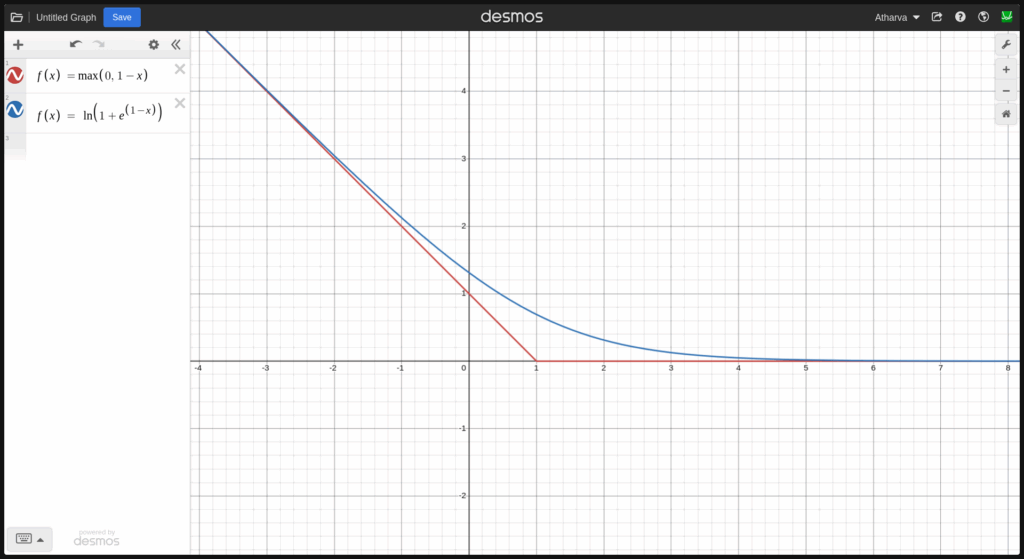
    On googling smooth function of ReLU we figured out something called as a SoftPlus Funtion . You can simply google it for a structured definition but basically it is a function which smooth ens a ReLU function making it differentiable, i.e in this case not making the y zero at any instance. It is defined for a RELU as :

    y=ln(1+ex)

    . Graph is attached at the end of the blog

    This allows us to find the derivative of the Soft Plus Function:. This again has a formal function name which is Sigmoid Funtion. We will discuss about this is our next blog.

    2.4. Why to have a smooth version of the Hinge Function ?

    The whole point of talking about comparison with ReLu and then SoftPlus, and finally differentiating it get a sigmoid function is to make it differentiable.This is required us to work with something called a gradient descent and also to figure out the mapping rule for the smooth Hing Loss Function.

    Author: atharva

    Created: 2025-10-03 Fri 23:59


    Hinge Loss and SoftPLus side by side
    Hinge Loss