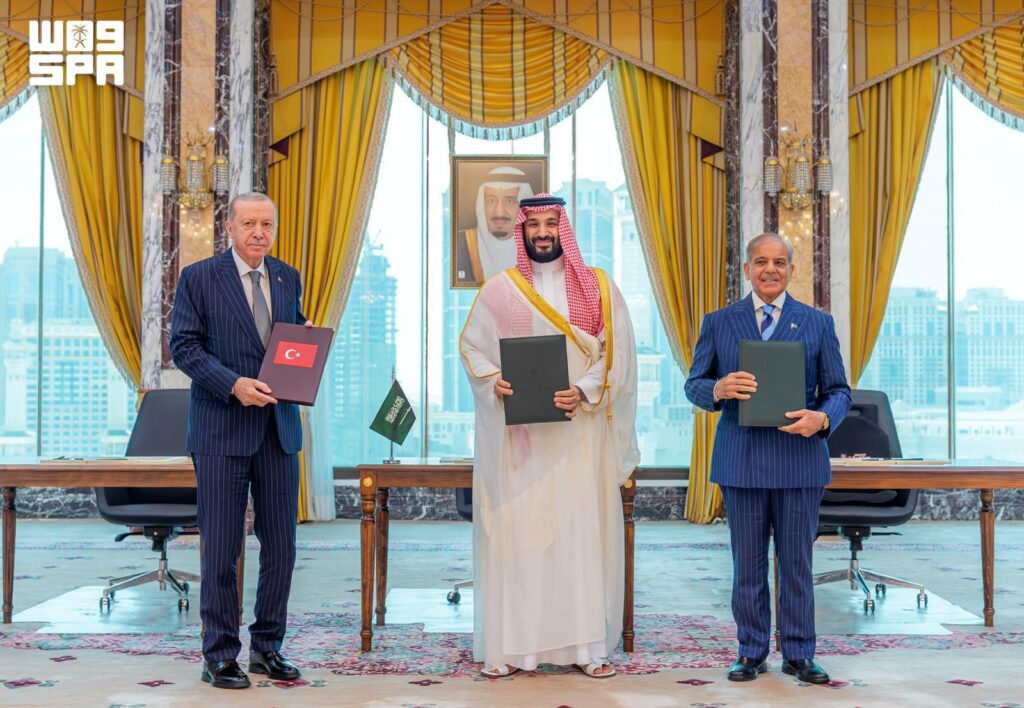
The Makkah Joint Defense Act (MJDA) is a joint act between three countries(Saudi Arabia, Türkiye, and Pakistan) that took place in early August 2026. The official texts of the act have not been published yet, but one of the major repercussions of this agreement is that these three countries have declared that a war waged against any one of them would be considered a war against all three, ensuring mutual retaliation. Scholars believe that this act is analogous to NATO (the North Atlantic Treaty Organization) in Europe and North America. Critics also informally call this the origin of a Muslim NATO. They believe that this will bring about major changes in the geopolitics of Western Asia and South Asia.
India will also have to heavily factor this into its geopolitical strategy and planning, mostly because of the tensions between India and its neighboring country, Pakistan.
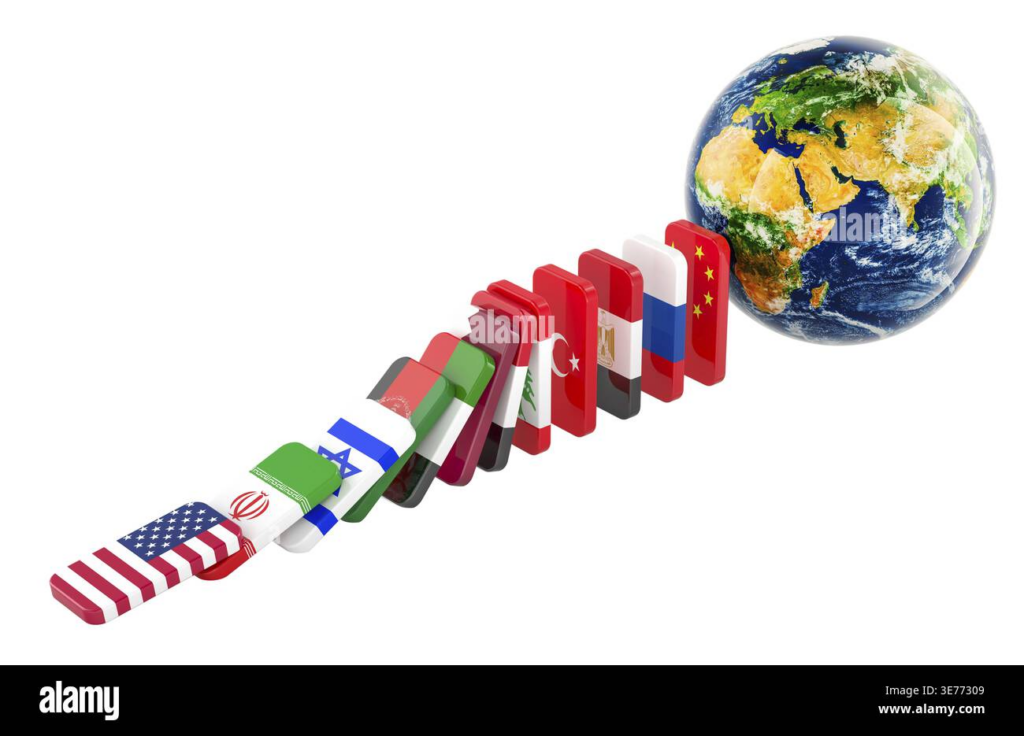
I think that policies like this have some benefits for the participating countries, but at the same time, they could also act as a pivotal catalyst for warlike situations through something that I call a “Geopolitical Chain Reaction.” Take, for example, a country that is a part of one such treaty while also being a part of another: Türkiye exemplifies this. So, for example, if India were to retaliate against terrorist activities within its borders via planned attacks on terrorist organizations in Pakistan, there is a possibility that, since Türkiye is a part of both NATO and the MJDA, NATO member countries might be triggered by this. Of course, this is a highly unlikely scenario, but it is still worth examining.
The 21st century is often cited as the information era. The access to information is now ubiquitous. You can pretty much access any information that you want from any corner of the world in matter of seconds, and in other words, as Naval says, we are in the Age of Alexandria.
This comes with (as it is with any other idea or phenomenon on Earth) both pros and cons. You all must be well aware of the pros (and a lot of cons too), but today I would like to emphasize on the latter and give you a different PoV.
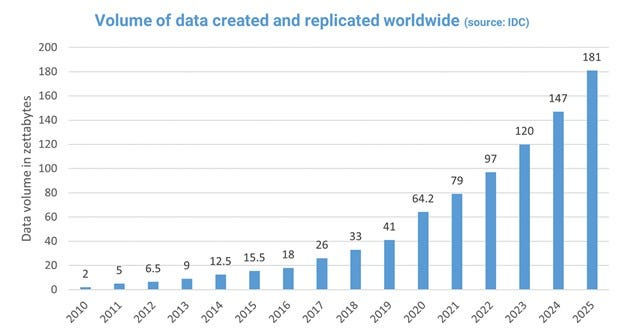
The volume of information that we generate and process each day has grown exponentially over the last few decades.
This leads to a natural problem that we as a species have to face: we haven’t evolved enough to process such a vast amount of information (much of it random) on a regular basis.
Thus, we feel consumed by the information world and overwhelmed. Feelings and emotions like anxiety, paranoia, uneasiness ,and mental fog can be back-linked to this feeling of being overwhelmed due to information.
We often feel that we need to do something because of this anxiety, which leads to a natural evolutionary freeze response. This can, again, be linked to phenomena like procrastination, unproductivity, more consumption of the information that led you to this miserable state (yes!).
So, a natural question arises: how do we combat this?
There are several books and methods on the internet (lol) that claim to benefit a lot of people in tackling this, but the one that I came up with (or maybe some idea from a book that is stored in my subconscious, but consider novel) involves the following two methods. The latter is the novel one.
Cold Turkey: Often referred to as digital detox or information detox over the internet, the idea of cold turkey precedes our era. Alcoholics from ancient Roman times might have used it to get rid of their drinking habits, Albert Einstein went cold turkey and never smoked a cigarette after being in the habit since his formative years due to his lung reports, Carl Jung went cold turkey on his other obligations for his work in a rock tower and retreated there whenever he wished to get some deep work done, and Bill Gates famously had think weeks where he went cold turkey for one or two weeks in a year where he would go to some remote location with loads of books, papers, and a pen to think about great ideas. The list continues.
The idea behind going cold turkey is pretty straight forward (especially in our current era). Big tech companies, media houses, and people at the top want to earn. A lot of these earnings come from the information sector. These people have real skin in the game and have real incentive to keep the vast majority of people engaged in worldly affairs. They get food for their family on the table because of this. Think instagram, youtube, reddit, media houses, and news floating around all over the internet. These services earn because of you. Their incentive is to keep you engaged and hooked as much as possible. They pay nerd people ( think mathematicians, psychologists, computer scientists) in hundreds of thousands dollars (and even millions) to have algorithms which make you, in short, addicted.
This is one of the core reasons of this “information overdose”. And the way out? Yes! Going cold turkey. You might think that you can control your urge of not using these apps if you wish but remember those people getting paid in thousands of dollars? they are not making free money!
The single most effective way is to go cold turkey. Delete all social media platforms (unless your job depends on it, lol), become hard to reach (for the unwanted information to reach you of course, although a general approach isn’t bad either), stop all unwanted sources of information (think TV news, gossip, and pseudoscience information)
Don’t Care
It’s often the case that we think that we are required to act on certain information; no you don’t. Think times like WW1, WW2, September 11 attacks, 2008 market crisis, Covid-19, AI boom, Elon Musk becoming a trillionaire, and Trump going insane. All these moments are pivotal. These are not ordinary moments. This is exactly what makes us think that we need to act to do something and get involved in this. This instinct is sometimes beneficial too (think buying Bitcoin early because your friend told you that its going to be a big thing or thinking to pursue computer science in the 1980s because you think that the future lies in this), but the thing with this instinct is that it often distracts us from our current focus and does not often yield into something really important.
The feeling is almost similar to FOMO on a very big thing, but you need to understand that you as of now might not have real skin in the game to actually benefit from whatever is fascinating you. This FOMO often leads to unfinished goals like academic goals , career aspirations , projects , and your self-esteem.
II am not telling you to go and sit under a rock but to understand that you need to have sufficient fundamental information based on which you need to decide how pivotal this new big thing is and how can you add value to your life without shifting your entire google calendar and abandoning all your current projects.
Note: the above tips are not for situations like a zombie apocalypse or an alien invasion. In these situations, yes your google calendar should not be your first priority but saving your soul 🙂
I try to read everyday. It doesn’t matter what you are reading in the beginning (I am in that beginning). It is the habit of reading that is the hardest part for a human to develop in his reading journey. You can start reading dense works by authors like Deutsh and Taleb(I have tried doing that and even understood a bit of it), but it doesn’t lasts very long.
Instead,what I learned from Naval, one should read anything that he likes without the concerning the metric of it being valuable, dense, productive, etc. There is no doubt on the fact that there are good and bad books, and one should always stick to the former as much as possible, but due to the circumstance that we discussed in the first paragraph, one never really knows what good books actually are. Granted, there exists books which are universally approved to be high in value (often buzz books like Atomic Habits, Deep work, Rich Dad Poor Dad)and everyone should always give them a try, but more important, still, is to niche down to the books that you are actually excited to read and not because a random short form content told you do so.
I myself am a beginner in the domain of reading. I try to read anything that I feel like reading. For example, I read a 100 page book in a single day just because I liked its title. Further, I occasionally read fiction. I often try to stick to non-fiction for the most part because I think there is more value in that specific genre for “me” at this point in my “life”. This does not contradict with Naval’s initial statement. I still read non-fiction which I really love to read with no additional expectations. Simply put, read just because of its own sake and expect no gain in the beginning (although you always will). Read everything that you can get your hands on.
Book Recommendation: Almanack of Naval by Eric
Most Books Should Be Skimmed, A Few Should Be Devoured.
I got an opportunity to interact with Sandeep Kumar this week, and to hear profound ideas and stories from all genres of life. Be it language learning, traveling, painting, or writing, he is truly felt like a polymath to me. He has served over 36 years as a Diplomat at the Government of India in various Indian Embassies around the globe. Specifically Dublin, Zagreb, Kabul, Cape Town, Hong Kong,Paris, and Hanoi.
I developed a narrative while he shared ideas about his experiences in different nations about how diplomacy works, and also how to enjoy the other spectrum of life. He truly was a testament to a book I have recently started reading, Slow Productivity by Carl Newport. One of the key insight that I have truly started to believe is that we don’t have to abandon the fulfilling nature of life in order to achieve excellence in a particular domain; he made it clear that there is no doubt in putting in deep work for things that matter to you and developing a level of excellence, but at the same time he shared with us that the key here is “Balance”.
Today I came across an idea on the internet about stereotypes, and I would love to share it with you in a brief.
It is a very common phenomenon for an individual to believe that they cannot do a certain activity because their “identity” doesn’t match. For example, someone might think that they are really good at bodybuilding, and start to believe that they cannot study math because their “personality” doesn’t match it. Another example could be somewhat opposite: a person might believe that he is a nerd, or he thinks that way because the society has made him to think that way, and because of that very reason he starts to think that he cannot dance or sing, for example.
The important thing to learn from this phenomenon is that you can be whatever you want to be. You can be mathematician who loves to cook. You can be a guitarist who goes to gym. You can be a physicist who loves barbie movies.
Hence, do not restrict yourself just because you want to be confined to a particular community. The idea agrees on the fact that stereotypes exists for a reason, but there are always exceptions.
I often find myself rescheduling things on my calendar just because I missed them on my calendar at the first place. There was math review that I had to make this evening which would take about 2 hours of work and kept doing non-deepwork, which made me complete only 25% of the desired task in 2 hours. Therefore I had to reschedule everything that followed just to accommodate this. I don’t how to fight this problem(if you do, email me right away), but i believe that a *consolidation* block in your calendar each day of about 30-60 min can really help you achieve your calendar goals
It feels really different to not do the daily habits that you formed over weeks and months for a week because of some personal cause or festival.
There is a friction after you come out of that break, and it feels to let go all the friction. But from what I experienced today(the same feeling), I think it is really hard. But there is a work around. Try to bare minimum to keep up with your calendar and commitments (don’t push them). I think just keeping some what of a streak for the initial few days after the break helps us to gain momentum to go full fledged in next few days or a week.
I like festivals because these are the times when I can voluntarily skip on my calendars.
I thing that I realized this diwali was to not schedule anything on your calendar on festivals or you will end up rescheduling and pushing deadlines anyways.
Understanding sequences and series. I haven’t proved Limit Theorems yet. As a consequence, currently my proofs are restricted to back thinking. We find the required n_0(e) for which n> n_0 proofs our initial limit by intuition . I will probably start with these theorems tomorrow.