Blog

  • Understanding AI

    blog 8

    Table of Contents

    1. Understanding AI

    2. Background

    It’s been almost four weeks since I became a student in the Beyond AI Research program by Thinking Beyond, and it has reshaped the way I think about Artificial Intelligence and how someone like me, who is completely new to this domain, should approach it. This post is a replacement for the continuation of the blog where we discussed the Hinge Loss function because I realized that the previous entry wasn’t a great post, especially in its choice of topic. This will be a reflective blog where I will reflect on this journey and share some tips I learned along the way. Here we go.

    3. Read Books

    This has to be one of the key lessons I took away from Prof. Filip Bar, who was our instructor and mentor for this program. He mentioned that attending AI YouTube courses or programs like this one will make you think you are learning, but it is all just on the surface level. Sure, watching a 12-hour PyTorch course would be beneficial to some extent, right? It sure will. But how far have you “understood” it? I am not suggesting removing all digital sources for learning (that would be one of the most terrible ideas of this century), but to start using textbooks as your primary source for knowledge intake (even a digital PDF or documentation will be just as effective).

    4. Break Concepts Down to Their Atoms

    Okay, maybe the title is a bit of an exaggeration, but the key idea is that for any given topic, you need to break it down into smaller pieces to understand it to a level beyond which it becomes insignificant for your task. For example, if I had to study EMG, I would have several subtopics like: What is EMG? How does it work? How do we process the signal? How do we amplify these signals? Why do we amplify them? What is amplification? And so on (if necessary).

    5. Don’t Use LLMs or GPTs for Every Usecase

    This is something which I have personally learned the hard way. Since the advent of AI GPTs in November 2022 (ChatGPT), I have used them for everything: writing emails, LinkedIn posts, image generation, idea generation, essay editing, help with homework, and everything else you can imagine. And guess what all of this led to? A dependency on AI for every task to the point that whenever I tried to think something on my own, I found it very difficult.

    All this needed to be changed. The change was slow but gradual. It began last year when I started typing my own LinkedIn posts and has continued to now, where I am trying to improve my writing skills by drafting a blog every day.

    I am not 100% convinced that humans are getting replaced by Artificial Intelligence anytime in the near future. People like my past self are the ones digging their own graves for this pseudo-replacement. If there is one piece of advice that you should take away from this post, it is to get as much valuable knowledge as you can, as fast as you can (a sentiment I’ve adapted from one of my math instructors).

    Author: S Atharva

    Created: 2025-10-05 Sun 00:09

  • Hinge Loss


    1. Table of Contents

      • 2.1. Introduction   
      • 2.2. Comparison with ReLU
      • 2.3. Discovering Softplus function and applying it
      • 2.4. Why to have a smooth version of the Hinge Function ?

    2. Hinge Loss


    2.1. Introduction   ATTACH

    I worked on an assignment which asked us to make a mapping rule for a smooth Hinge Funtion which is attached at the last of the blog.

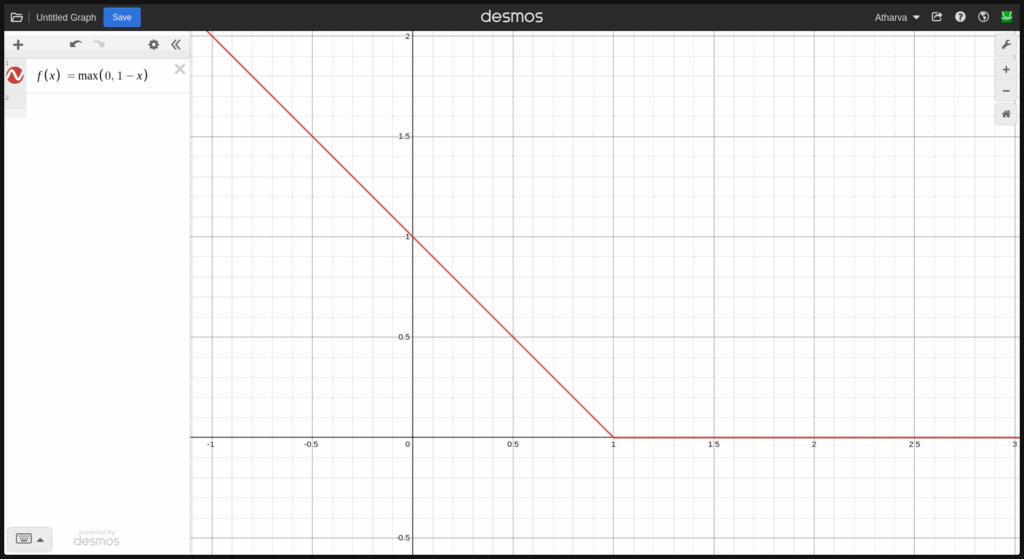
    So basically a hinge loss function is a function for binary classification that aims to maximize the margin between two data clouds.

    Suppose that that the two data clouds are apple and banana and we want to make a binary classifier which separates them

    2.2. Comparison with ReLU

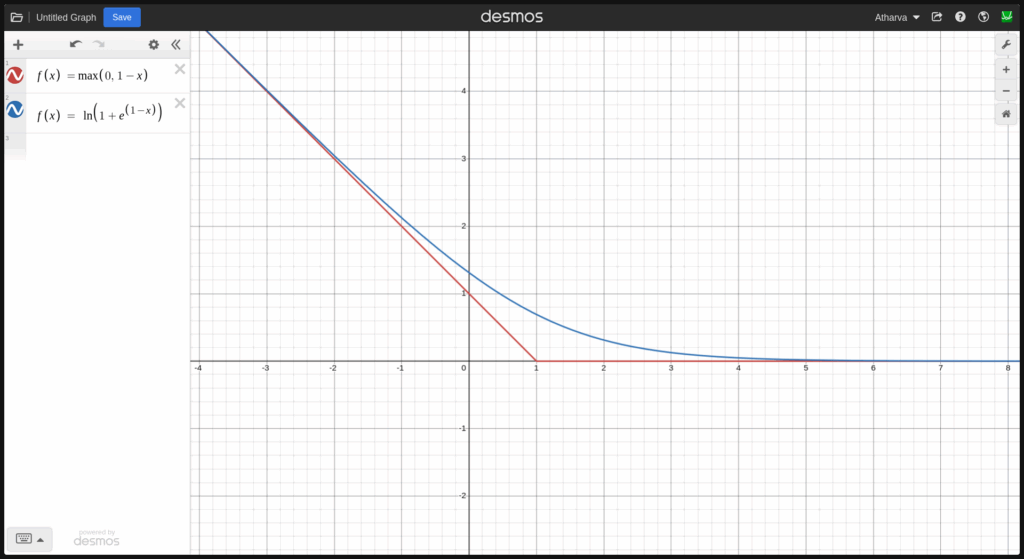
    Me and my team compared this hinge loss function to a ReLU function( Rectified Linear Unit ), and figured out that it was a function which gave binary output but has threshold on the origin instead of what our case was ,(1,0). Anyways the function , Hinge Loss  very similar to that of the ReLU.You can see that it as follows: ReLU -> y=max(0,x& Our Hinge Loss ->y=max(0,(1x))

    .

    2.3. Discovering Softplus function and applying it

    On googling smooth function of ReLU we figured out something called as a SoftPlus Funtion . You can simply google it for a structured definition but basically it is a function which smooth ens a ReLU function making it differentiable, i.e in this case not making the y zero at any instance. It is defined for a RELU as :

    y=ln(1+ex)

    . Graph is attached at the end of the blog

    This allows us to find the derivative of the Soft Plus Function:. This again has a formal function name which is Sigmoid Funtion. We will discuss about this is our next blog.

    2.4. Why to have a smooth version of the Hinge Function ?

    The whole point of talking about comparison with ReLu and then SoftPlus, and finally differentiating it get a sigmoid function is to make it differentiable.This is required us to work with something called a gradient descent and also to figure out the mapping rule for the smooth Hing Loss Function.

    Author: atharva

    Created: 2025-10-03 Fri 23:59


    Hinge Loss and SoftPLus side by side
    Hinge Loss
  • learning doom emacs

    Table of Contents

    • 1. learning doom emacs
      • 1.1. Background
      • 1.2. Linux
      • 1.3. Emacs
      • 1.4. Doom Emacs
      • 1.5. Why still windows 11
      • 1.6. Would I recommend this to the reader

    1. learning doom emacs

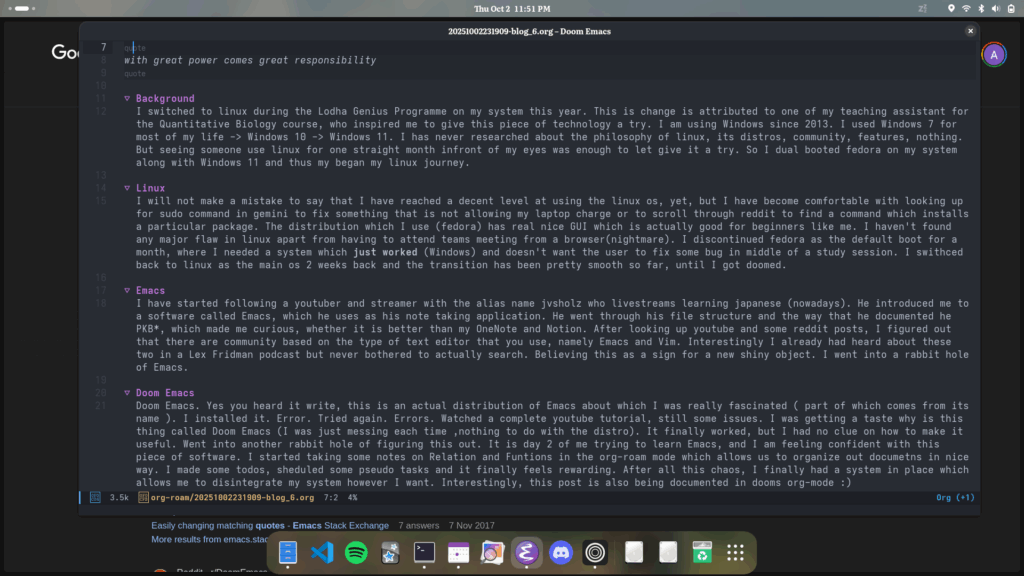
    with great power comes great responsibility

    1.1. Background

    I switched to linux during the Lodha Genius Programme on my system this year. This change is attributed to one of my teaching assistant for the Quantitative Biology course, who inspired me to give this piece of technology a try. I am using Windows since 2013. I used Windows 7 for most of my life(till now) -> Windows 10 -> Windows 11. I have never researched about the philosophy of linux, its distros, community, features, nothing. But seeing someone using linux for one straight month in front of my eyes was enough to convince me to give it a try. So I dual booted fedora on my system along with Windows 11 and thus began my linux journey.

    1.2. Linux

    I will not make a mistake to say that I have reached a decent level at using the linux os, yet, but I have become comfortable with looking up for sudo command in gemini to fix something that is not allowing my laptop charge or to scroll through reddit to find a command which installs a particular package. The distribution which I use (fedora) has real nice GUI which is actually good for beginners like me. I haven’t found any major difficulty in using linux apart from having to attend teams meeting from a browser(nightmare). I discontinued fedora as the default boot for a month, where I needed a system which just worked (Windows) and doesn’t want the user to fix some bug in middle of a study session. I switched back to linux as the main os 2 weeks back and the transition has been pretty smooth so far, until I got doomed.

    1.3. Emacs

    Recently I started following a youtuber and streamer with the alias name jvsholz who livestreams learning japanese (nowadays). He introduced me to a software called Emacs, which he uses as his note taking application. He went through his file structure and the way that he documented he Personal Knowledge Base, which made me curious, whether it is better than my OneNote and Notion. After looking up youtube and some reddit posts, I figured out that there are community based on the type of text editor that you use, namely Emacs and Vim! Interestingly I already had some idea about these two due to a Lex Fridman podcast which I watched but never bothered to actually search. Believing this as a sign for a new shiny object. I went into a rabbit hole of Emacs.

    1.4. Doom Emacs

    Doom Emacs. Yes you heard it right, this is an actual distribution of Emacs about which I was really fascinated to use ( part of which comes from its name ). I installed it. Error. Tried again. Errors. Watched a complete youtube tutorial, still some issues. I was getting a taste why is this thing called Doom Emacs (I was just messing each time ,nothing wrong with the distro). It finally worked, but I had no clue on how to make it useful. Went into another rabbit hole of figuring this out. It is day 2 of me trying to learn Emacs, and I am feeling a little bit confident with this piece of software. I started taking some notes on Relation and Functions in the org-roam mode which allows us to organize your documents in nice way. I made some todos, sheduled some pseudo tasks and it finally feels rewarding. After all this chaos, I finally had a system in place which allows me to disintegrate my system however I want. Interestingly, this post is also being documented in dooms org-mode : )

    1.5. Why still windows 11

    Why I still have windows 11 as a dual boot? I have some exam which requires a windows application to practice and attempt mock test. Will I completely switch to linux once the exam is done? Maybe. Will I keep using Emacs? Definitely.

    1.6. Would I recommend this to the reader

    So after reading this blog, will I recommend linux or emacs to you? yes! should you blindly just download arch and try out a whole week how to get your bloated windows 11 back? absolutely not. It really depends on your personal goals and willingness to learn such an advance piece of software and os. What level I am on this hierarchy of learning? 0, zero, zilch, kein. But will I keep trying? a 100%. So if you are someone who is into organization, then sure, give Emacs a try, who knows that you may become its fan too! danke, sayonara.

    Author: atharva

    Created: 2025-10-02 Thu 23:59

  • deep work

    Es irrt der Mensch, solang er strebt.

    Man errs as long as he strives.

    I was reading a book called “deep work” by carl newport last month, which I haven’t quite finished(time to start reading it again), and it changed the way I look at productivity.

    he talks about how the intensity at which you work at really defines how productive you are. he believes that the focus with which you perform a particular task is equally important as the amount of time you do it, if not more. you may try doing a task for 12 hours with a low level of focus and get the task done somehow, whereas a person with intense focus could get the same task done in 3 hours of deep focus block (arbitrary example). One major flaw with the first approach is that it makes the person believe that this task actually required 12 hours and meanwhile this stark number of 12 hour of work also makes the person feel motivated to continue doing this habit.

    trust me when i say this, “it is very easy to devote long hours to things which have a net positive impact on your life once you get these things in your life, but the true optimum(or rather maximum) is achieved when this act is used in its most robust form” The list follows.

    • Social Media Detox
    • A passion
    • motivation (* from the passion, not instant motivation -> that would take you at max weeks or some months not more than that)
    • and lastly “order”

    I want to emphasize what I meant by “order” in the above list. Order can be thought of as in contrast to “pure chaos”, where you have no control of what is happening in your life, misery, no direction, no motivation, et cetra. For our purpose order could be thought of as organization and how you conduct yourself though this journey.

    Coming back to the initial point, carl newport also provides use with a equation to quantify (again, intuition) our high quality deep working hours, which could be understood by the image attached below.

    book recommendations:

    • deep work
    • digital minimalism
    • *A note: the above mentioned list is not something which the author came up with from ground up, but referred from his learning of the books and the resources that he reads which stayed in his subconscious.
  • biphasic sleep

    According to some sources, Sir Isaac Newton used to sleep only 2 hours a day (working 22 hours everyday). Some famous people including Leonardo da Vinci, Nikola Tesla, and Thomas Edison used to follow a specific type of sleep, called polyphasic sleep. “poly” referring to “many” and “phasic” referring to “phases”, i.e. sleep in many phases/cycles.

    Polyphasic sleep is historically linked to polymaths who optimized day for better productivity. Polyphasic sleep contrasts to traditional monophasic sleep.

    The term “polyphasic sleep” was coined by J. S. Szymanski,a psychologist who observed daily fluctuations in sleep activity patterns.

    nowadays monophasic sleep is the norm, but history suggests something else. It suggests that polyphasic sleep was common practice in many societies before industrialization.My reasoning why the practice dwindled after industrialization is as follows:

    Industrialization required people to work for long hours every day, especially men, therefore not allowing room for sleep in chunks throughout the day.

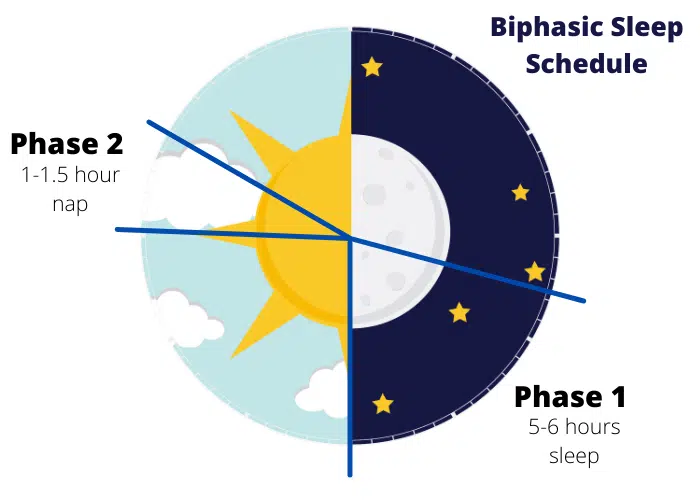
    I personally follow a specific phase type sleep known as “biphasic sleep”. A person sleeps in two chunks in 24 hours instead of the normal 7-9 hour sleep at night. If you take a 1-2 hour nap during afternoon then you too follow a biphasic sleep schedule unknowingly!

    As far as I have practiced this sleep schedule, I classify this in two sub categories

    • 4-4 hour schedule
    • 6-2 hour schedule

    I regularly try to get 6-7 hours of sleep, usually following the the 6-2 hour schedule ( slightly adapted -> (4-2.5 ) ). As of september 2025, I try to sleep around 23:30-24 and wake up at 5 A.M. . The next sleep phase starts around 14:00 or 15:00 and goes till 16:00 or 17:00 depending on the situation, respectively.

  • what is imposter syndrome

    if something is important enough, you still do it even if the odds are against your favor. ~Elon Musk


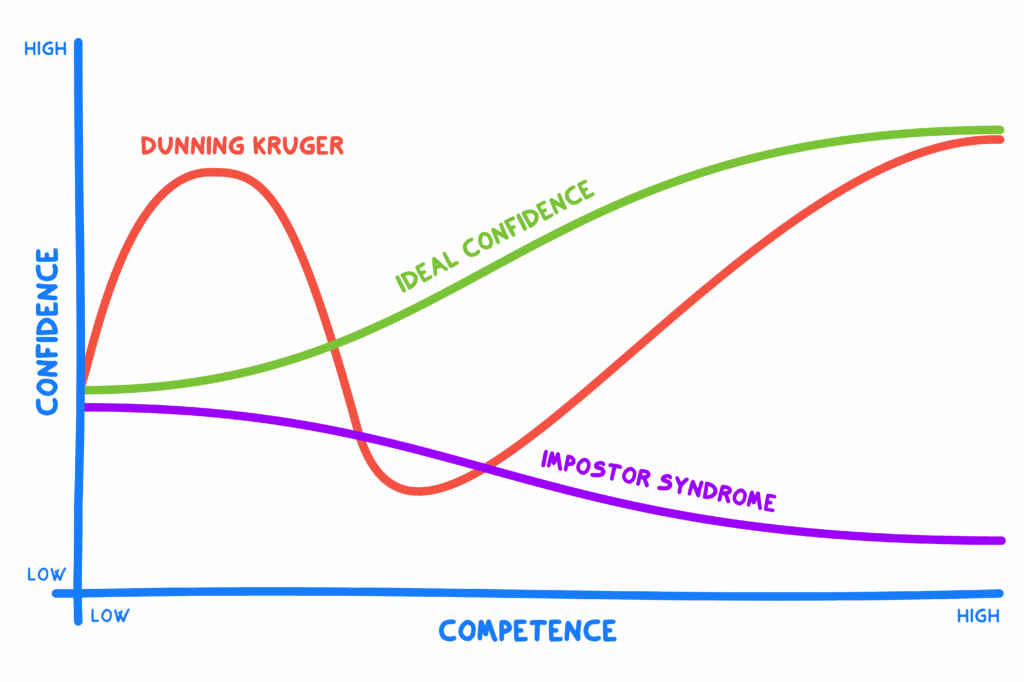
    yesterday i discussed the dunning-kruger effect and how people overestimate their ability at a certain skill, especially when they are just beginning to crawl. i also mentioned how there are two negative trajectories to the dunning-kruger effect. one is that one is not able to confront the reality and quits altogether. the other (which we are going to talk about) is that a person still keeps on learning and advancing in the skill parallel with the “ideal confidence” (ignoring time as a parameter here) but doesn’t gain confidence in their abilities to do work.

    this scenario is called the imposter syndrome. According to Wikipedia, stated as follows:

    a psychological experience in which a person suffers from feelings of intellectual and/or professional fraudulence.

    in many cases, the trigger for such a scenario could be comparing yourself with people who are, again, far ahead of you in the ladder of competence hierarchy. it is often stated as comparing your day one with someone else’s day thousand.

    by now i believe you got the understanding of what this syndrome really deals with. you might ask what could be a potential solution to this? and personally i haven’t figured that out yet myself. there are several narratives of how one looks at their drive for life. for example, a person like david goggins thrives by comparing himself to every other person in the world and that fact keeps a person like him going. if he doesn’t outwork his competition he isn’t succeeding according to him, which is completely fine for his use case.


    the above-mentioned example may or may not work for you, and the fun part is you might never come across a pre-existing solution for your specific problem.


    one thing that often helps me is to just follow your calendar (no matter if agi is invented). just sticking to what you are doing consistently and walking on your own trajectory is, in most cases, a better decision than giving up your entire calendar for chasing some other shiny objects.

    a video recommendation on the above topic

  • why being humble is important

    A year ago, I watched a lecture by Lex Fridman on YouTube that discussed the Dunning-Kruger effect, and it’s a video I find myself returning to every now and then.

    According to Wikipedia, the Dunning-Kruger effect is stated as follows:

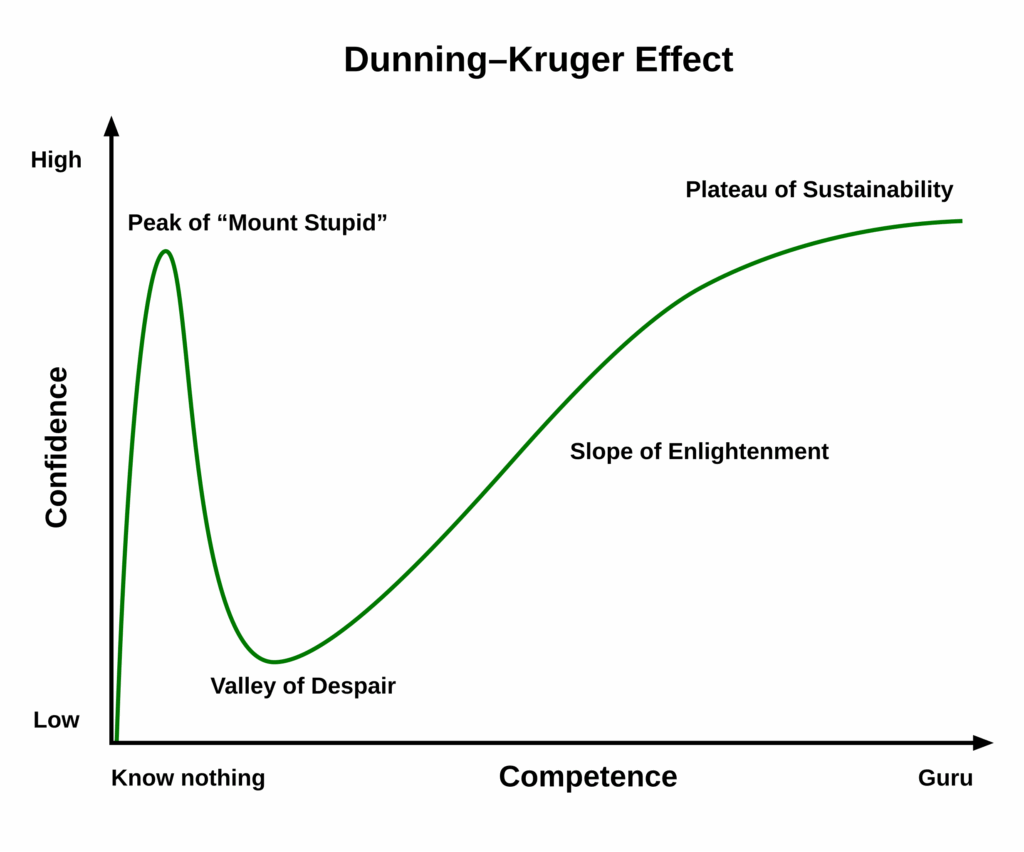
    The Dunning–Kruger effect is a cognitive bias in which people with limited competence in a particular domain overestimate their abilities

    Basically, this effect describes how people new to a field or domain try to comprehend their expertise after some initial learning. Their confidence skyrockets. They overestimate their skill level.

    I myself have been a part of this curve in many domains in my life(and am currently in the “valley of despair” in a few of them). The primary thing to learn from this effect is that it is not bad to feel good about one’s ability in a particular skill but to have a real benchmark and be humble in each competence level(assuming competence to be discrete). I myself try to be humble about everything I know and everything I don’t.

    The problem isn’t falling into the valley of despair, but that most of the people don’t even continue their competence journey once they are confronted with this reality. The real value to take away is to be persistent with your learning and never assume yourself to be the top of the world because there is always someone in some corner of the world who is performing far better than you.

    It is usually a good practice to stay around people (offline or online) who are further along the competence hierarchy, so that you stay grounded.

    unfortunately, I haven’t been able to find the link to the specific youtube video which has been referred to here. If you happen to find it, please email me at atharva{at}atharvasingh.com

  • how i revived my old thinkpad( and my childhood memories)

    a man finds pleasure in the most unimportant things amidst chaos


    i had my cs exam today. it went well, but what i want to talk about today is how, under the umbrella of preparing for my cs exam, i disguised myself and tried to fix my 12-year-old lenovo thinkpad l412.

    i probably am everything that you associate me with because of that thinkpad. my father gifted me this laptop on my fifth birthday in 2013. i remember playing road rash, surfing the internet on internet explorer, searching for the tallest man in the world, et cetera (good old days). i remember making scratch programs for flappy bird while watching a youtube tutorial.

    so, it did have some emotional memories associated with it, too.
    anyway, i opened that old mess up with just one screwdriver. this really is crazy compared to what laptop companies provide us with nowadays: soldered ram, soldered hard disks, and no back screws (why?). i figured out that the installed ssd was corrupted, and therefore, for it to work, i needed a bootable usb. i created a fedora bootable usb and plugged it in. i played around in the bios, then in the terminal, and it somehow worked.

    i am happy that it is working right now, but will i use it daily? maybe not. it is maxed out with 8 gb of ram (sounds funny? it is) and with an intel i5 processor. still, it doesn’t get done what my new device can. anyway, i’m happy that it revived some of the old memories and taught me how to remove an ssd from a laptop.