1. Table of Contents
-
- 2.1. Introduction
- 2.2. Comparison with ReLU
- 2.3. Discovering Softplus function and applying it
- 2.4. Why to have a smooth version of the Hinge Function ?
2. Hinge Loss
2.1. Introduction ATTACH
I worked on an assignment which asked us to make a mapping rule for a smooth Hinge Funtion which is attached at the last of the blog.
So basically a hinge loss function is a function for binary classification that aims to maximize the margin between two data clouds.
Suppose that that the two data clouds are apple and banana and we want to make a binary classifier which separates them
2.2. Comparison with ReLU
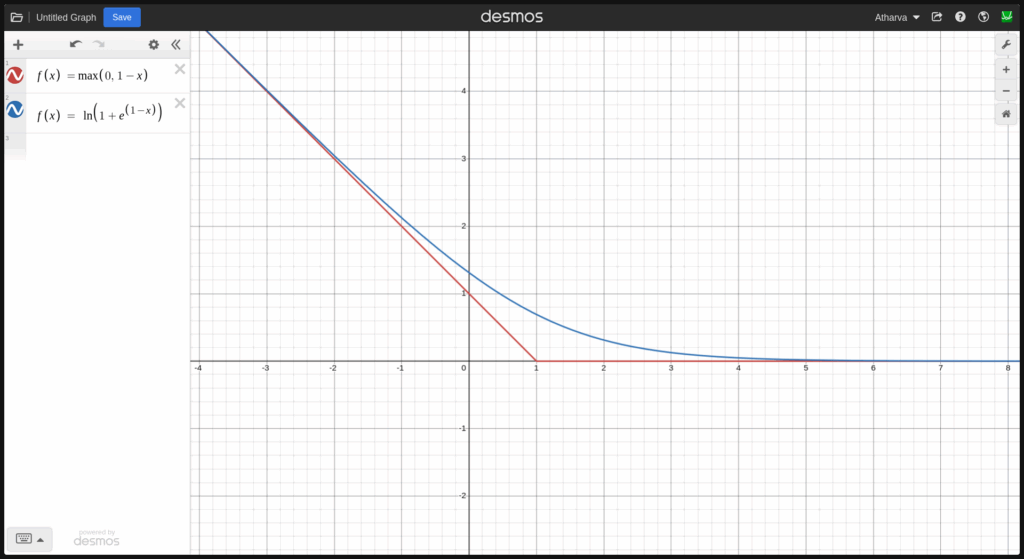
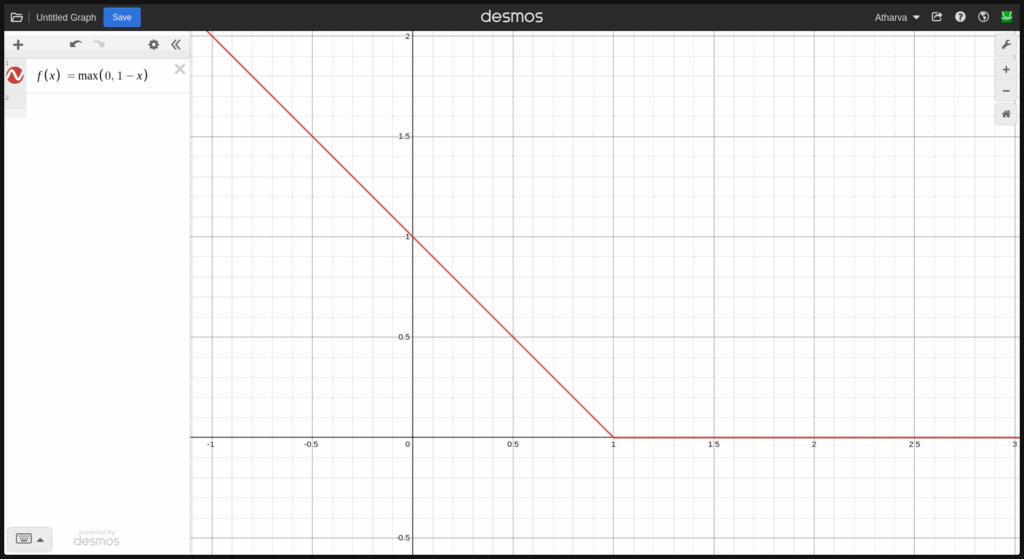
Me and my team compared this hinge loss function to a ReLU function( Rectified Linear Unit ), and figured out that it was a function which gave binary output but has threshold on the origin instead of what our case was ,(1,0). Anyways the function , Hinge Loss very similar to that of the ReLU.You can see that it as follows: ReLU -> & Our Hinge Loss ->
.
2.3. Discovering Softplus function and applying it
On googling smooth function of ReLU we figured out something called as a SoftPlus Funtion . You can simply google it for a structured definition but basically it is a function which smooth ens a ReLU function making it differentiable, i.e in this case not making the y zero at any instance. It is defined for a RELU as :
. Graph is attached at the end of the blog
This allows us to find the derivative of the Soft Plus Function:. This again has a formal function name which is Sigmoid Funtion. We will discuss about this is our next blog.
2.4. Why to have a smooth version of the Hinge Function ?
The whole point of talking about comparison with ReLu and then SoftPlus, and finally differentiating it get a sigmoid function is to make it differentiable.This is required us to work with something called a gradient descent and also to figure out the mapping rule for the smooth Hing Loss Function.
Created: 2025-10-03 Fri 23:59